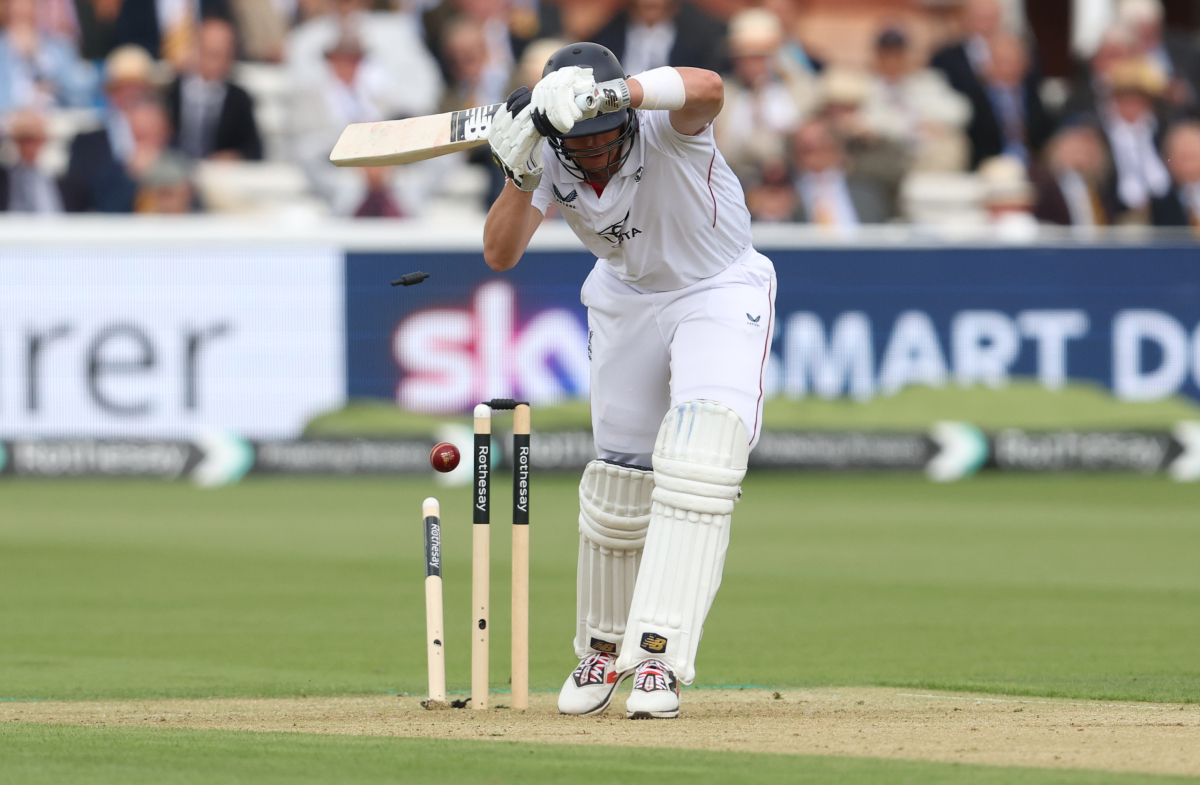

With England taking a 1–0 series lead, 60% of all dismissals came via bowled or lbw. That is a significant deviation from the established pattern in English Test history, where no completed match has previously gone beyond 53% for those forms of dismissal. The surge points strongly to a surface that consistently favoured pace bowlers and offered constant assistance.
In the entire history of English cricket, there has never been a Test where more than 53% of wickets were bowled or lbw in a completed match. This one had 60%. pic.twitter.com/pil7qWwr4C
— Jarrod Kimber (@ajarrodkimber) June 7, 2026
New Zealand, set a target of 254, were bowled out for 138 before lunch on the fourth day, bringing an end to a contest that had been dictated by conditions from the opening session. Gus Atkinson’s 5-30 sealed the victory, while Ollie Robinson’s 7 wickets in the match reinforced England’s control with the ball.
Dot. Dot. Wicket. Dot. Wicket. Wicket.
Every ball from that ridiculous Ollie Robinson over 👇 pic.twitter.com/A5jhEgkV1p
— England Cricket (@englandcricket) June 4, 2026
Throughout the game, batters rarely looked settled. Only two fifties were scored, Harry Brook’s 56 and Emilio Gay’s composed 57 on debut, as both teams found it difficult to handle uneven bounce and late movement. From the first day, which produced 16 wickets, it became clear that occupying the crease would be more valuable than scoring freely.
England captain Ben Stokes expressed concern about the surface after the match. He described it as “not ideal for Test cricket”, highlighting the inconsistent bounce that troubled batters throughout. Former England captain Nasser Hussain was more direct in his criticism, labelling the pitch “not good enough” for a venue with Lord’s standing.
New Zealand captain Tom Latham accepted the challenge posed by the conditions but noted that both sides faced the same difficulties. MCC officials also acknowledged that the pitch did not behave as intended.
By the conclusion, England had secured the win, New Zealand had endured a heavy collapse, and the match delivered a statistical quirk that may outlast the result itself. It was a Test dominated overwhelmingly by bowlers striking the stumps or trapping batters in front at a rate never previously recorded in England’s Test history.
Photo: David Rogers/Getty Images